
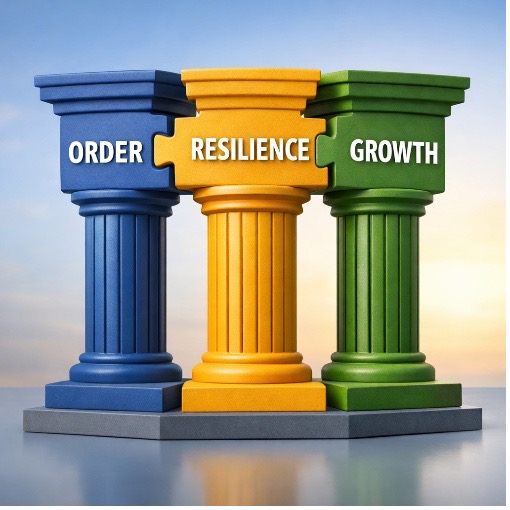
1. Order: Creating Structure in a Dynamic Environment
Order is the foundation of sustainable planning.
For individuals:
- Understanding income vs expenses
- Planning around irregular income streams
- Preparing for tax and statutory obligations
For SMEs:
- Proper bookkeeping and financial records
- Cash flow visibility (not just profit)
- Budgeting for compliance, taxes, and operational costs
In a region where informal systems are common, order is a competitive advantage.
When your numbers are clear, decisions become confident.
2. Resilience: Planning for Uncertainty
Resilience is not a buzzword — it’s a necessity.
Strategic planning helps individuals and SMEs:
- Prepare for delayed payments
- Build emergency buffers
- Plan around currency fluctuations and market shifts
- Absorb shocks without panic
Resilience is not about eliminating risk.
It’s about anticipating it and planning responses in advance.
Strong businesses don’t avoid challenges; they’re built to withstand them.
3. Growth: Scaling Responsibly in Our Context
Growth opportunities are real, but growth without structure is risky.
Strategic growth means:
- Expanding at a pace your cash flow can support
- Hiring intentionally
- Understanding the true cost of growth
- Ensuring compliance keeps up with expansion
More sales do not automatically mean more profit; especially when costs, taxes, and operations are not aligned.
Sustainable growth is intentional, measurable, and supported by systems.
Why Strategic Planning Matters More Than Ever
In today’s business environment:
- Hustle alone is not enough
- Speed without structure creates burnout
- Growth without planning leads to instability
Strategic planning gives individuals and SMEs:
- Financial clarity
- Decision-making confidence
- Control in uncertain times
At Finorms, we don’t believe in one-size-fits-all plans.
We design strategies that reflect local realities, regional markets, and practical execution.


Leave a Reply